Antonio Acconcia

Antonio Acconcia

Welcome! I am a Professor of Economics at the Department of Economics and Statistics of the University of Naples Federico II, and a Research Fellow at the Centre for Studies in Economics and Finance (CSEF).

My research is primarily empirical, focusing on topics in public economics, regional inequalities, and law enforcement.

Antonio Acconcia

Welcome! I am a Professor of Economics at the Department of Economics and Statistics of the University of Naples Federico II, and a Research Fellow at the Centre for Studies in Economics and Finance (CSEF).

My research is primarily empirical, focusing on topics in macroeconomics, regional inequalities, law enforcement.

Selected Publications

Firms’ performance after demand contractions and firm exits

with Elisa Scarinzi
Applied Economics, 2026

The stabilizing effect of elected women and political seniority

with Carla Ronza
European Journal of Political Economy, 2026

Consumption and liquidity shocks

with Simone Chinetti and Tullio Jappelli
Italian Economic Journal, 2025

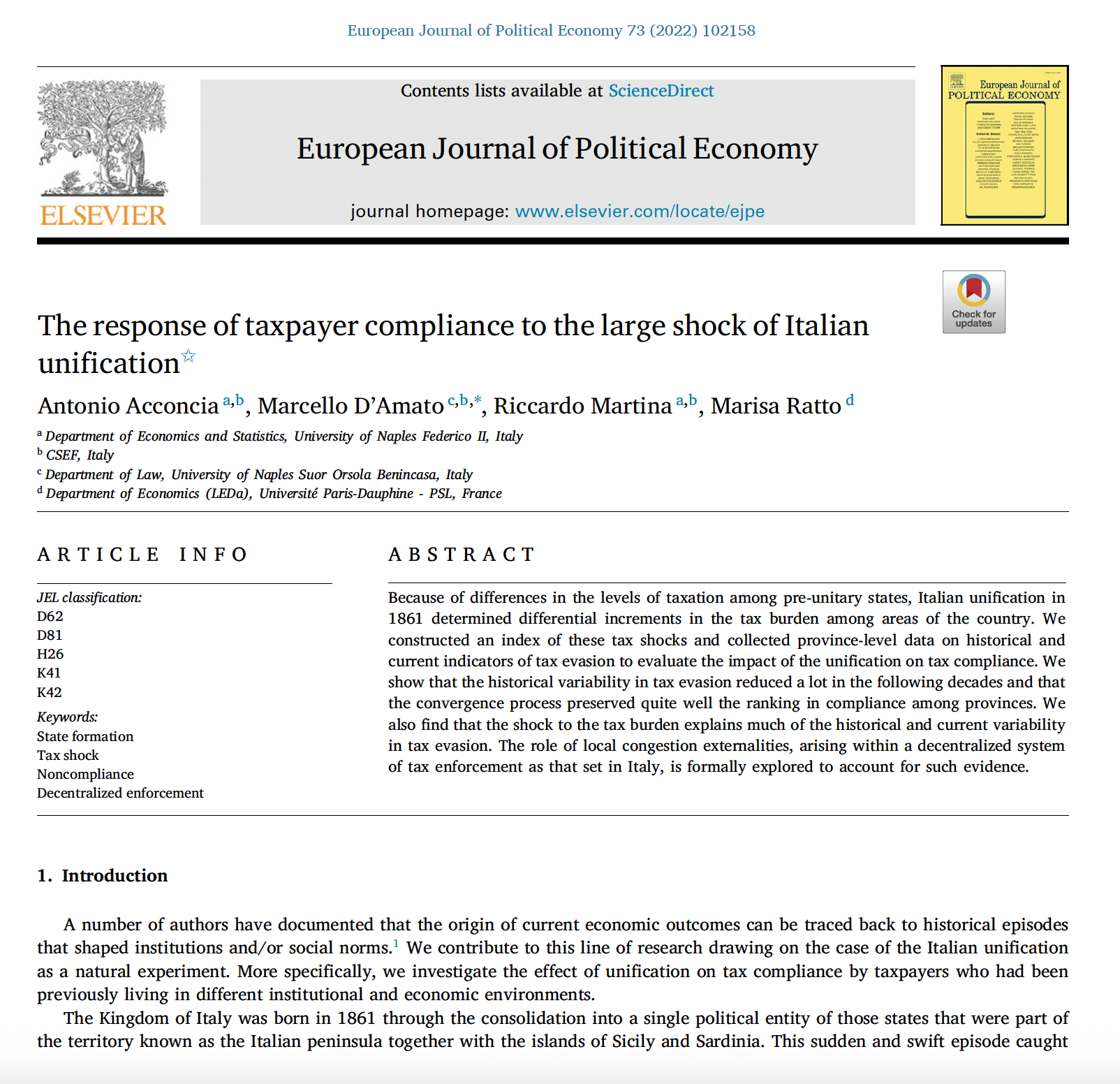
The response of taxpayer compliance to the large shock of Italian unification

European Journal of Political Economy, 2022, Vol. 73
The paper exploits the historical shock of Italian unification to study tax compliance. Italian unification in 1861 determined differential increments in the tax burden among areas of the country due to differences in pre-unitary taxation levels. We evaluate the impact of this shock on tax compliance, showing that historical variability in tax evasion reduced significantly in the following decades. The findings indicate that the ranking of compliance among provinces remained largely preserved and that the shock to the tax burden explains much of both historical and current variability in tax evasion.

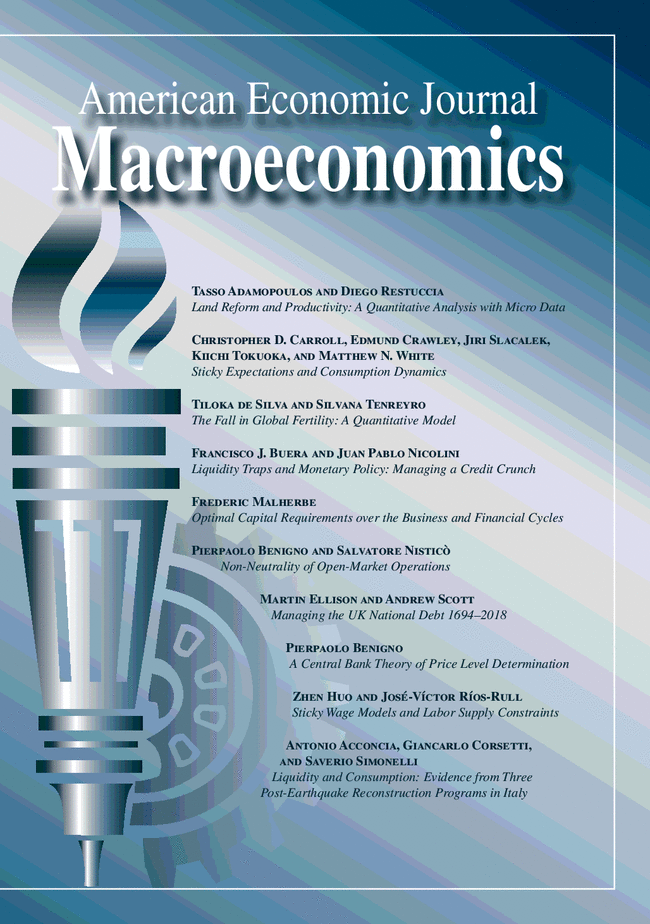
Liquidity and Consumption: Evidence from Three Post-Earthquake Reconstruction Programs in Italy

American Economic Journal: Macroeconomics, 2020, Vol. 12, pp. 319–346
In Italian regions hit by earthquakes, homeowners typically receive public funds to finance reconstruction. While these funds are strictly tied to reconstruction work, they are in part disbursed up front, leading to significant variation in cash on hand. We exploit this variation to study the effects of liquidity on relatively wealthy households’ consumption. We find a large and significant response in the first year that homeowners receive the cash and provide evidence that this response is driven by illiquid households with bank debt. Instead, we find no evidence that consumption responds to funds paid directly to firms, thus leaving households’ liquidity unaffected.

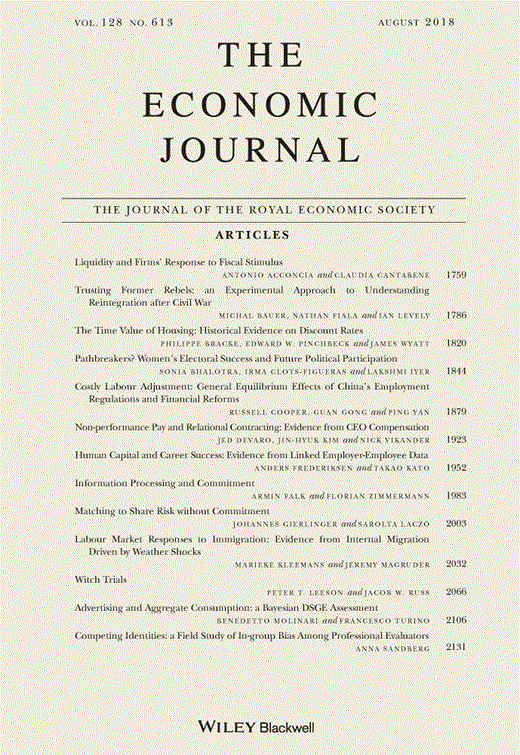
Liquidity and Firms’ Response to Fiscal Stimulus

The Economic Journal, 2018, Vol. 128, Issue 613, pp. 1759–1785
A stimulus programme allowed firms in Italy to receive tax credits for R&D expenditure in 2009. Among traditional firms, liquidity is relevant to the response to the stimulus: recipients firms with relative large cash holdings raised R&D expenditure, while those with low liquidity did not vary it. High‐tech firms did not change their total R&D, consistent with their tendency to smooth R&D expenditure through time, though they changed its composition in favour of outsourcing activity and to the detriment of employment. When the fiscal stimulus pushed R&D higher, it also induced a positive transitory effect on the firm’s performance.
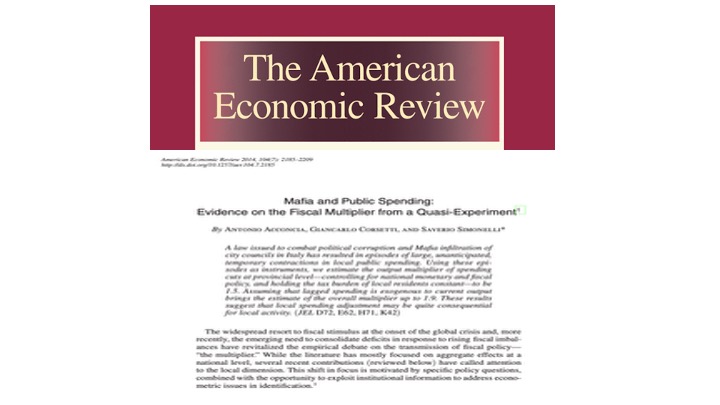
American Economic Review, Vol. 104, Issue 7
A law issued to combat political corruption and Mafia infiltration of city councils in Italy has resulted in episodes of large, unanticipated, temporary contractions in local public spending. Using these episodes as instruments, we estimate the output multiplier of spending cuts at provincial level—controlling for national monetary and fiscal policy, and holding the tax burden of local residents constant—to be 1.5. Assuming that lagged spending is exogenous to current output brings the estimate of the overall multiplier up to 1.9. These results suggest that local spending adjustment may be quite consequential for local activity.

Accomplice Witnesses and Organized Crime: Theory and Evidence from Italy

The Scandinavian Journal of Economics, 2014, Vol. 116, Issue 4, pp. 1116–1159
We develop an agency model of organized crime accounting for the main trade-offs involved in the introduction of an accomplice-witness program. We characterize the optimal policy and identify its main determinants in a framework where public officials can be dishonest. Our predictions are tested by using data for Italy before and after the introduction of the 1991 accomplice-witness program. As predicted by the model and the earlier antitrust literature, the program appears to have strengthened deterrence and enhanced prosecution. Moreover, consistent with a novel prediction of our theory, the evidence suggests that the program efficacy is affected by the judicial system efficiency.

Interpreting aggregate fluctuations looking at sectors

Journal of Economic Dynamics and Control, 2008, Vol. 32, Issue 9, pp. 3009–3031
This paper relies on sectoral-level data to interpret aggregate fluctuations of labor productivity and employment in the US as due to exogenous disturbances. By using a dynamic factor model to investigate the variability in labor productivity and hours across the 2-digit US manufacturing industries, two kinds of shocks emerge as quantitatively relevant during the postwar period: technology shocks to the production of equipment and economy-wide shocks. Our findings suggest that looking at sectors is key to understanding the nature and the transmission of aggregate shocks.

Vertical Restraints Under Asymmetric Information: On the Role of Participation Constraints

The Journal of Industrial Economics, 2008, Vol. LVI, Issue 2
The impact on vertical contracting of a type-dependent reservation utility is investigated within a sequential monopolies environment with asymmetric information. The welfare and private properties of contracts controlling both the retail price and the sales level are compared with those restricting only sales. When firms choose contracts non-cooperatively, retail price restrictions are desirable for the up-stream supplier although detrimental to consumers, whenever the retailer reservation utility has a relevant impact on optimal contracts. If this impact is relatively weak and contracts are chosen cooperatively, vertical price control fails to maximize firms’ joint-profit although it would be beneficial to consumers.

On growth and infrastructure provision

Research in Economics, 2000, Vol. 54, Issue 3, pp. 215–234
Investment decisions are usually affected by what firms perceive as government supply constraints: when a firm considers whether to increase its capital stock it takes into account possible constraints due to the lack of public productive services. Introducing this consideration in a simple growth model with public services subject to congestion, I derive the possibility of low development traps for economies which start with a low level of private capital stock. At the same time, multiple equilibria, that is different long-run outcomes consistent with the same fundamentals, arise. Under some circumstances, an increase of the flow of public productive services could drive away the economy from the poverty trap. For growing economies, growth rate is positively related to the share of public spending on productive services. Empirical evidence at country level accords with implications of the model.

Work in Progress

Firms’ capital structure and employment in the aftermath of the 2008-09 financial crisis / CSEF Working Paper

with Daniela Fabbri and Anna Maria C. Menichini

Public certification, information asymmetry, and investment / CSEF Working Paper

with Anna Laura Baraldi, Maria Rosaria Alfano and Claudia Cantabene

The transmission of economic shocks from firms to workers

with Simone Chinetti and Elisa Scarinzi

Tax evasion and proximity

with Marcello D’Amato and Riccardo Martina

Short Bio

2025
Head of Department DiSES
2019–24
Deputy Head of Department DiSES
2014–18
Degree Program Coordinator

MSc in Economia e Commercio

2013–14
Degree Program Coordinator

MSc in Concorrenza e Regolamentazione

2010-13
PhD Program Coordinator

Economics

2004-
CSEF Research Fellow

Teaching

Courses

Topics in Macroeconomics: Empirical Analysis – Master, 2026–, EN

Econometrics – 2002-, IT

Microeconomics – 2023-, IT

Time Series Econometrics – Master, 2001-2025, EN

Econometrics II – PhD, 2019-2024, EN

Miscellaneous